

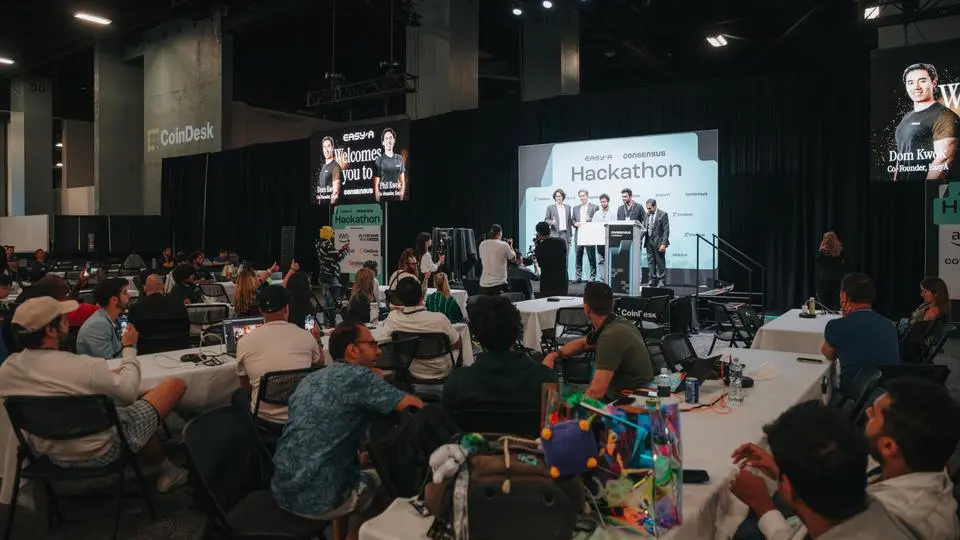
The EasyA Hackathon at Consensus Miami 2026 was dominated by artificial intelligence agents, as nearly 1,000 developers from crypto ecosystems such as Base and Solana, alongside engineers from Microsoft and Google, raced to build AI-native startups. The event showcased a wide range of projects, including autonomous payments, consumer applications, hardware generation, drones, and prediction markets.
The hackathon, organized by the EasyA platform founded by Dom and Philip Kwok, has transformed from a simple crypto coding competition into a launchpad for billion-dollar startups. Past participants have gone on to raise significant venture funding, join Y Combinator, and build companies now valued in the billions.
This year's focus on AI agents reflects a broader trend in the crypto and tech industries: the convergence of decentralized blockchain technology with advanced artificial intelligence. Developers leveraged platforms like Base, a layer-2 network built on Ethereum, and Solana, known for its high throughput and low transaction costs, to create applications that use AI agents to automate complex tasks.
The Rise of AI Agents in Crypto
AI agents are autonomous programs capable of performing tasks, making decisions, and interacting with other systems without constant human intervention. In the crypto space, they are being used for automated trading, portfolio management, decentralized finance (DeFi) operations, and even governance. The Consensus Miami hackathon provided a fertile ground for these innovations, with teams working around the clock to prototype their ideas.
One notable project involved an AI agent that autonomously executes payments based on predefined rules, leveraging smart contracts on Solana for instant settlement. Another team built a consumer app that uses AI to recommend and execute token swaps based on user preferences and market conditions. Hardware generation projects used AI agents to design and prototype new devices for mining or decentralized wireless networks. Drones equipped with blockchain-based identity and payment systems were also demonstrated, allowing for autonomous delivery services. Prediction markets were enhanced with AI agents that aggregate data from multiple sources to set and adjust odds in real time.
Ecosystems and Collaborations
The involvement of major tech companies like Microsoft and Google highlights the growing interest in crypto-AI synergies. Microsoft engineers participated in the hackathon, bringing expertise in cloud AI services and large language models. Google engineers contributed knowledge in machine learning and data processing. These collaborations helped bridge the gap between traditional tech and the decentralized world.
Base, the Ethereum layer-2 ecosystem incubated by Coinbase, provided infrastructure and grants to teams building on its platform. Solana, with its emphasis on scalability, attracted projects requiring high-frequency interactions with AI agents. The diversity of ecosystems allowed developers to choose the best fit for their applications, fostering a competitive yet collaborative environment.
Economic and Social Impact
The hackathon underscored the potential of AI agents to create new economic models. For instance, autonomous payment systems could revolutionize micropayments, enabling new revenue streams for content creators and service providers. Consumer apps that integrate AI agents could simplify crypto adoption for non-technical users, reducing friction in wallets and exchanges. Hardware generation and drones point to physical-world applications, where AI agents manage logistics, supply chains, and autonomous vehicles.
Prediction markets driven by AI agents could provide more accurate forecasts for events ranging from sports outcomes to political elections, leveraging decentralized data feeds and collective intelligence. The social implications are significant: such markets can democratize information and reduce manipulation by central authorities.
Developer Experience and Growth
EasyA has become a key hub for developer talent in the crypto space. Dom Kwok emphasized that the hackathon is designed to go beyond coding; it includes mentorship sessions, pitch practices, and networking opportunities with venture capitalists. Many participants joined with initial concepts and left with working prototypes and investment offers. The atmosphere was intense but supportive, with teams sharing resources and debugging help.
The presence of nearly 1,000 developers indicates a thriving ecosystem hungry for innovation. It also shows that despite market fluctuations, interest in building decentralized applications with AI remains strong. The hackathon saw contributions from both seasoned crypto developers and newcomers from traditional tech, leading to cross-pollination of ideas.
As AI agents become more sophisticated, their integration with blockchain could lead to completely autonomous organizations (DAOs) that run on self-executing smart contracts and AI decision-making. This hackathon provided a glimpse into that future.
Winning teams among the 50+ that presented received prizes including funding, cloud credits, and fast-track entry into accelerator programs. However, many non-winners also reported interest from investors. The event concluded with a showcase where each team demoed their project to a panel of judges including venture capitalists and ecosystem leaders.
The legacy of Consensus Miami 2026 EasyA hackathon will likely be measured not just by the projects built, but by the network effect of developers who now understand how to combine AI and crypto. As Philip Kwok noted, the next billion-dollar startup could have started at a table in Miami, powered by an AI agent and a blockchain.
Source: Coindesk News