

Top News
SpaceX's Record-Breaking IPO and Expanding AI Ambitions
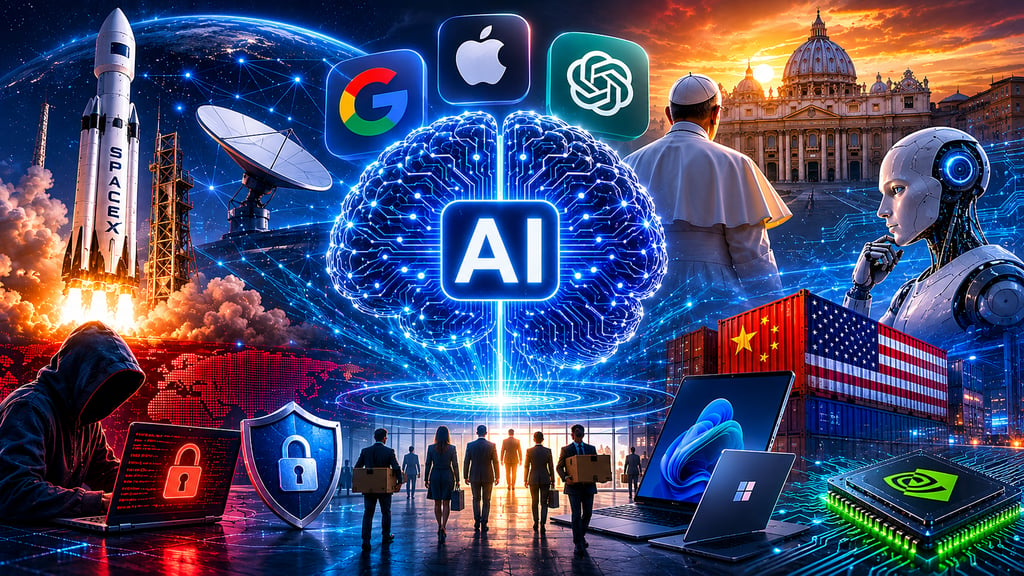
SpaceX filed its S-1 for a record-setting IPO, seeking to raise up to $75 billion at a valuation above $1.5 trillion under the ticker SPCX. The company's Starlink division now drives most revenue and profit, though heavy AI investments have led to short-term losses. Elon Musk retains 85% voting control and could earn a massive bonus if ambitious goals are met. The IPO is expected to be one of the largest in history, drawing comparisons to Alibaba's 2014 debut. Starlink's subscriber base has grown to over 4 million, providing critical internet access in remote areas. The IPO proceeds will fund further Starlink satellite launches and AI development for autonomous spacecraft operations.
AI in the Spotlight: From Google to Apple
At Google I/O 2026, CEO Sundar Pichai introduced the "agentic Gemini era," unveiling three new AI models: Gemini 3.5 Flash for speed, Gemini Omni for multimodal tasks, and Gemini Spark for edge devices. These models are designed to manage autonomous tasks across Google's ecosystem, from search to cloud services. Key features include real-time translation, code generation, and personalized assistant functions. Meanwhile, Apple is preparing Siri's biggest AI overhaul yet for WWDC 2026, adding AI writing tools, natural-language shortcuts, and privacy-focused controls. The update aims to better compete with Google and Samsung in the AI assistant space. Industry analysts expect Apple to partner with OpenAI for backend processing while maintaining on-device privacy.
Anthropic, OpenAI, and the Vatican Enter the AI Ethics Arena
The Vatican is taking a bold step into AI ethics. Anthropic co-founder Christopher Olah joined Pope Leo XIV for the launch of an AI-focused encyclical exploring technology's impact on human dignity and labor. The upcoming document, "Magnifica Humanitas," will formally address AI's societal and moral implications, including automation's effect on employment and the need for ethical frameworks. This marks the first time a papal encyclical has focused on technology. Elsewhere, Anthropic announced new monthly credit caps for its Claude Agent SDK, ending flat-rate compute pricing and sparking developer backlash. Many developers argue the caps limit experimentation and increase costs for small teams. OpenAI is reportedly considering legal action against Apple over ChatGPT's integration into Apple Intelligence, citing disputes over visibility and revenue sharing. The conflict highlights growing tensions between AI providers and platform giants over data control and monetization.
AI Shifts in Industry and Workforce
Detroit automakers are undergoing a massive transformation, cutting over 20,000 white-collar jobs as General Motors, Ford, and Stellantis pivot toward AI-driven operations. The cuts target engineering, design, and administrative roles, with AI handling tasks like supply chain optimization and autonomous driving software. Simultaneously, Gen Z is pushing back against AI adoption. A recent survey found that nearly half of young people believe AI's risks outweigh its benefits, citing job displacement, privacy concerns, and algorithmic bias. Protests have erupted at tech campuses, with students demanding more ethical AI development. Some companies are responding by creating dedicated AI ethics boards and offering retraining programs.
Hardware and Geopolitics
Microsoft launched new Surface AI PCs for business, featuring Intel Core Ultra Series 3 chips and dedicated NPUs for local Copilot tasks. The devices offer improved battery life and security features, targeting enterprise customers. Meanwhile, the US government approved Nvidia H200 chip sales to select Chinese firms, including Alibaba and Tencent, underscoring ongoing geopolitical tensions in the AI supply chain. The H200 is designed for AI training, and approval came with strict usage monitoring to prevent military applications. This decision follows months of lobbying by US tech companies concerned about losing market share in China.
Insider Intel
Wall Street analysts are skeptical of AI-driven layoffs, noting that over half of companies announcing such cuts see their stock prices fall. Experts argue that augmenting workers with AI yields better returns than replacing them. Many corporate AI initiatives may be more about optics than true transformation. For example, companies that invest in employee retraining and AI collaboration tools often outperform those that simply cut headcount. This week's data suggests investors are becoming more discerning about AI claims.
Security Alerts
Government and Corporate Breaches
- A CISA contractor accidentally exposed AWS GovCloud admin tokens and passwords on GitHub for six months, prompting congressional scrutiny. The incident exposed sensitive government data and raised concerns about contractor security practices.
- NYC Health and Hospitals suffered a breach exposing 1.8 million patient records, including biometric data. The attack exploited a vulnerability in third-party software, leading to lawsuits and regulatory investigations.
- A ransomware attack on American Lending Center compromised data of 123,000 individuals. The group demanded a $5 million ransom, but the company refused to pay, instead working with law enforcement.
Software Vulnerabilities and Exploits
- Google accidentally published exploit code for an unpatched Chromium bug that allows malicious sites to keep JavaScript running after the browser closes. The bug affects all Chromium-based browsers, including Chrome and Edge, leaving users vulnerable to persistent tracking.
- Ivanti, Fortinet, SAP, VMware, and others issued emergency patches for 11 severe vulnerabilities enabling remote code execution and data theft. Systems administrators are urged to apply updates immediately.
- A malicious VS Code extension compromised 3,800 GitHub repositories, injecting backdoors into open-source projects. Developers are advised to audit their dependencies and enable two-factor authentication.
Emerging Threats and Malware
The KongTuke hacking group is exploiting Microsoft Teams chats to deploy ModeloRAT malware via fake IT messages. The campaign targets corporate users, tricking them into downloading malicious attachments. On macOS, the Reaper infostealer is spreading through fake WeChat and Miro installers, stealing credentials and crypto wallets. Meanwhile, Discord added end-to-end encryption for calls but left text chats unprotected, raising privacy concerns. Security researchers recommend using verified download sources and enabling encryption where possible.
AI and Cybersecurity Trends
Verizon's 2026 Data Breach Investigations Report revealed that AI-driven exploits have surpassed credential theft as the leading cause of data breaches. The report analyzed over 20,000 incidents and found that generative AI is being used to craft more convincing phishing emails and automate vulnerability scanning. Organizations are urged to prioritize secure AI deployment and patch management. The shift underscores the dual-use nature of AI: while it powers innovation, it also arms attackers with powerful tools.
Industry Shakeups
Layoffs, Lawsuits, and AI Restructuring
Intuit announced 3,100 layoffs — about 17% of its workforce — to fund AI initiatives with OpenAI and Anthropic. Despite strong profits, shares fell over 20% amid investor skepticism. The company plans to integrate AI into TurboTax and QuickBooks, automating tax preparation and bookkeeping. In the legal arena, Elon Musk lost his lawsuit against OpenAI, clearing the way for the company's anticipated more than $1 trillion IPO and strengthening its partnership with Microsoft. The ruling affirmed OpenAI's conversion to a for-profit model and dismissed claims of antitrust violations.
Corporate Deals and Labor Negotiations
Google and Blackstone are forming a $5 billion joint venture to build a TPU-based cloud service for enterprises, aiming to expand AI compute access and challenge Nvidia's dominance. The venture will operate independent data centers powered by renewable energy. Meanwhile, Samsung offered chip-division workers $26.6 billion in stock-based bonuses and a 6.2% wage increase to avert a strike. The offer covers semiconductor engineers and factory workers, but could strain finances if the chip market cools later this year. Labor tensions remain high as the company faces competition from TSMC and Intel.
Source: TechRepublic News