

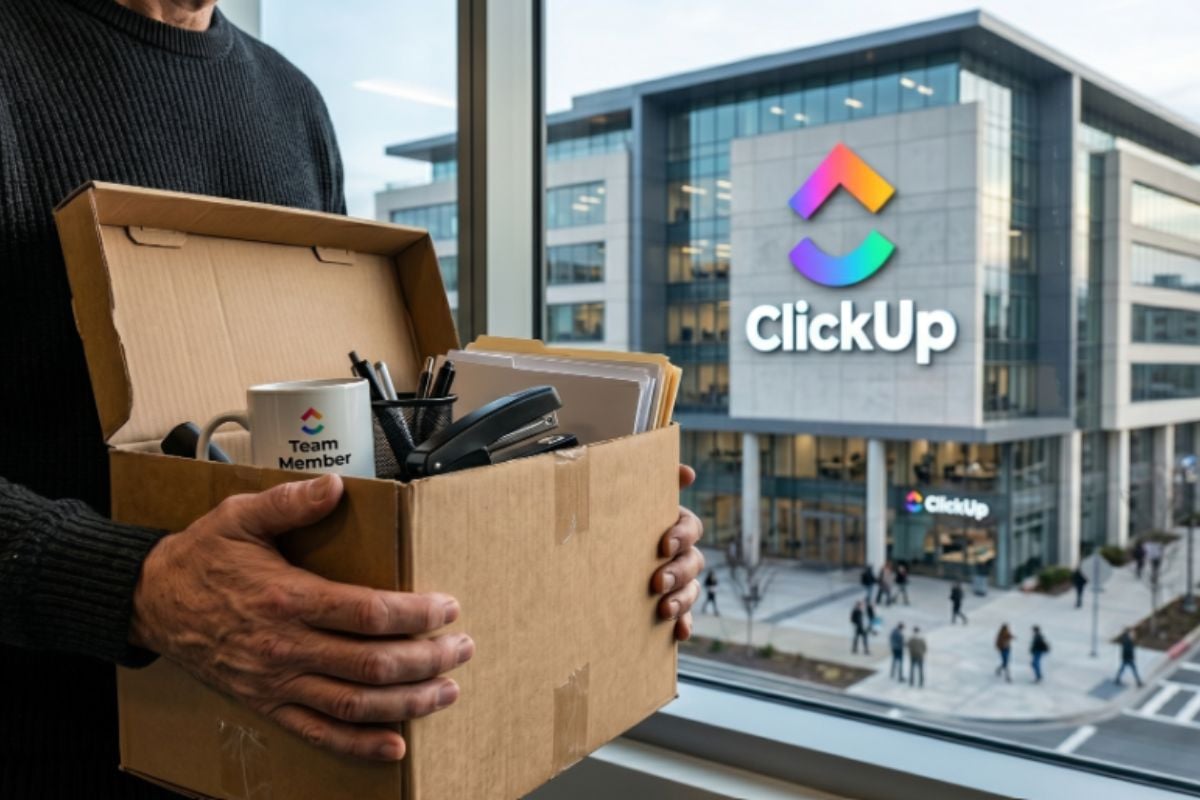
ClickUp, the cloud-based productivity software company, has laid off 22% of its workforce as part of a strategic reorganization centered on artificial intelligence. CEO Zeb Evans framed the cuts not as a cost-saving measure but as a fundamental shift toward an 'AI-first' operating model that he calls the '100x org.' The goal, according to internal announcements, is to achieve tenfold or hundredfold increases in output by equipping remaining employees with AI agents and expecting them to manage automated systems rather than perform all work manually.
The layoffs affect roughly 220 employees, based on previous headcount of around 1,000 in 2023. Evans wrote that most of the savings from the reduction will be reinvested into the retained workforce, including the introduction of million-dollar salary bands for employees who generate exceptional results using AI. 'If you create outsized impact using AI, you’ll be paid outside of traditional bands,' Evans stated in an internal memo cited by multiple outlets. The restructuring is one of the most aggressive examples so far of a software company betting that AI can dramatically shrink the need for human labor while boosting performance.
ClickUp's Journey to AI-First
Founded in 2017, ClickUp has grown rapidly, offering a comprehensive suite of project management, document collaboration, goal tracking, and communication tools. The company was valued at $4 billion in 2021 after a $400 million Series C round. By 2023, ClickUp had more than 1,000 employees and a customer base of over 800,000 teams, including enterprises like Google, Airbnb, and Netflix. The product's all-in-one approach aims to replace multiple standalone tools like Asana, Trello, and Slack, but that ambition also led to a complex feature set that sometimes overwhelmed users.
Under Evans's leadership, ClickUp has increasingly pushed AI into its platform. The company introduced ClickUp AI in 2023, offering automated writing, summarization, and task generation. More recently, it deployed approximately 3,000 internal AI agents to handle complex operations. These agents can automate workflows, analyze data, and execute tasks that previously required human intervention. Employees are now expected to direct these agents, review their output, and ensure quality — a role that Evans categorizes as 'builders,' 'system managers,' or 'front-liners.' Builders and system managers focus on automation and AI systems, while front-liners handle customer relationships.
One employee, growth operations manager Andy Cabasso, noted that he now oversees 37 AI agents, delegating routine tasks and focusing on strategic oversight. This model is central to ClickUp's vision of a lean, supercharged organization.
Industry Context and Implications
ClickUp’s move reflects a wider trend across technology companies. According to a recent Gartner survey cited by TechCrunch, about 80% of companies using autonomous technology have reduced their workforce, though the financial returns have not always matched the hype. Critics argue that cutting jobs too quickly can degrade product quality, customer support, and innovation capacity, especially if the AI systems are not yet mature. In ClickUp’s case, the reduction comes at a time when many SaaS companies are under pressure to show profitability after years of growth-at-all-costs spending.
The announcement has sparked debate about the role of human workers in an AI-driven enterprise. Some analysts see ClickUp’s strategy as a blueprint for future-proof companies, while others warn that it may alienate employees and ignore the nuanced benefits of human collaboration. For CIOs and business leaders, the lesson is clear: AI adoption requires careful policy design around oversight, security, accountability, and measurement. Simply slashing headcount does not automatically improve outcomes.
ClickUp is not alone in rethinking its workforce. LinkedIn recently announced job cuts across major teams despite revenue growth, citing a refocus on priorities. The broader tech industry has shed over 200,000 jobs in the past two years, with many firms specifically pointing to AI as a rationale. However, ClickUp’s explicit linkage of layoffs to an AI-first compensation model is distinctive.
How ClickUp's AI Agents Work
The internal AI agents at ClickUp operate across multiple domains. For example, agents can automatically prioritize tasks based on deadlines and dependencies, draft emails and documents, analyze project metrics, and even test software features. Employees set goals and parameters, then the agents execute and report back. This allows a single worker to handle the workload that previously required a team. Evans has claimed that the company’s productivity has already spiked, though specific metrics have not been publicly shared.
The compensation restructuring is designed to retain top talent who can leverage these tools effectively. The million-dollar salary bands are not guaranteed; they are reserved for employees who demonstrate 'outsized impact.' This could include a builder who creates an AI agent that saves the company significant time or a front-liner who uses AI to close large deals. The approach mirrors how some tech companies pay top engineers like athletes, but extends it to roles that adopt AI.
Challenges and Open Questions
Despite the optimistic narrative, several challenges remain. First, AI agents are still prone to errors, bias, and misinterpretation, which could introduce risks if human oversight is reduced too much. Second, the cultural shift from doing to managing requires different skills, and not all employees may adapt. Third, there is the question of scalability: can a '100x org' sustain itself over years, or does it eventually lead to burnout among the remaining staff who must constantly monitor machines?
Moreover, the layoffs may damage morale among departing and remaining employees alike. While Evans promises reinvestment, the immediate loss of colleagues and the uncertainty of new roles can undermine trust. ClickUp will need to demonstrate that its model delivers measurable improvements in customer satisfaction, innovation, and financial performance to justify the dramatic restructuring.
In the broader context, ClickUp’s strategy is a test case for the future of the software industry. If successful, it could accelerate the trend of lean, AI-augmented teams across other sectors. If it fails, it may serve as a cautionary tale about the limits of automation. For now, the company is forging ahead, betting that the combination of fewer people and more AI will produce extraordinary results.
As AI agents become more sophisticated, the line between human and machine labor will continue to blur. ClickUp’s experiment will be closely watched by investors, competitors, and employees across the tech landscape. The outcome may redefine what a modern company looks like.
Source: TechRepublic News