

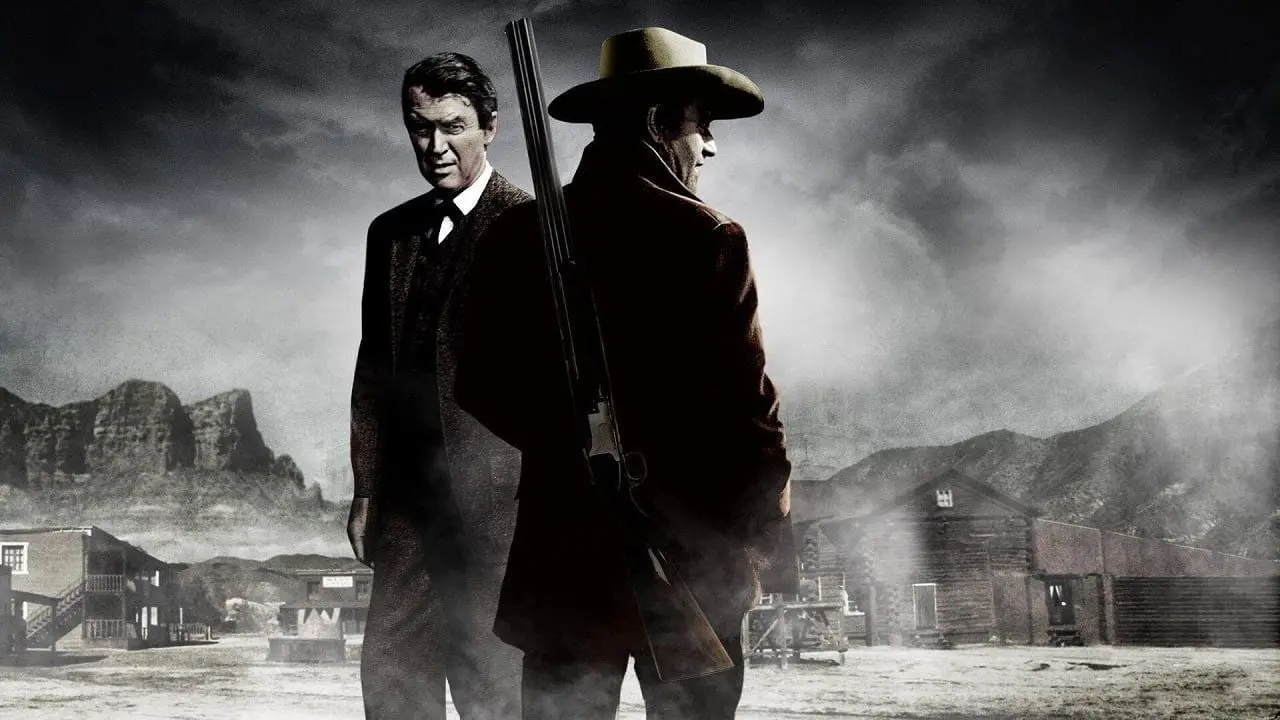
There are Westerns that thrill, Westerns that entertain, and Westerns that leave you breathless with their grandeur. Then there are Westerns that linger in your mind long after the credits roll – films that not only tell a story but also force you to question the very foundations of the myths they depict. John Ford's 1962 classic "The Man Who Shot Liberty Valance" belongs to this rare category. It is a film that is at once beautiful, witty, and profoundly disturbing.
The plot is deceptively simple. Senator Ransom Stoddard (James Stewart) arrives in the small frontier town of Shinbone for the funeral of his old friend Tom Doniphon (John Wayne). Pressed by a local reporter, he recounts the events that shaped his life and the town's destiny. Years earlier, Stoddard, a young lawyer with ideals of law and order, came to Shinbone from the East. He immediately clashed with the brutish outlaw Liberty Valance (Lee Marvin), who terrorized the community. While Stoddard believed in the power of the law, Tom Doniphon, a rugged rancher, knew that in the Wild West, only a gun could stop a gun. Their rivalry, complicated by their shared affection for the waitress Hallie (Vera Miles), leads to a confrontation that becomes the stuff of legend.
But legend, as the film suggests, is often a comforting lie. Ford and his screenwriters (James Warner Bellah and Willis Goldbeck) adapted Dorothy M. Johnson's short story with remarkable fidelity to its bitter core. The film's most famous line – "When the legend becomes fact, print the legend" – has become a shorthand for the film's cynical view of American history. Yet the film is far from cynical; it is melancholic and deeply human.
A Masterpiece of Melancholy
John Ford was no stranger to the Western. He had directed dozens of them, from silent epics to the iconic "Stagecoach" (1939) and the cavalry trilogy. But "The Man Who Shot Liberty Valance" is different. Shot in stark black-and-white (Ford's preferred medium for this story), the film strips away the romanticism of the Monument Valley vistas that defined his earlier works. Instead, the town of Shinbone is presented as a dusty, bleak place where the line between civilization and savagery is dangerously thin.
The performances are extraordinary. John Wayne, often associated with larger-than-life heroes, delivers a subtle, heartbreaking turn as Tom Doniphon. He is a man out of time, a frontiersman who understands that his way of life is ending. His quiet dignity and ultimate sacrifice give the film its emotional weight. James Stewart, as the idealistic lawyer, embodies the conflict between principle and pragmatism. Lee Marvin relishes the role of Liberty Valance, a villain of pure menace and cruelty. And Vera Miles brings a quiet strength to Hallie, the woman torn between two men.
What makes the film so powerful is its willingness to embrace complexity. It does not celebrate the taming of the West; instead, it mourns the losses incurred in the process. The film's humor, often provided by the character of the town drunk (played by Edmond O'Brien), never undermines the tragedy. It is a film that understands that progress often requires sacrifice, and that the stories we tell ourselves may be necessary fictions.
The Film's Place in Western History
Released in 1962, "The Man Who Shot Liberty Valance" arrived at a time when the Western genre was undergoing a transformation. The classic Hollywood Western was giving way to more revisionist takes, such as Sam Peckinpah's "Ride the High Country" (also 1962) and later "The Wild Bunch" (1969). Ford's film stands as a bridge between the old and the new. It honors the conventions of the Western – the shootout, the moral dilemma, the frontier setting – while simultaneously deconstructing them.
Ford himself considered this one of his most personal films. He was a master of the Western, but he was also a man who had witnessed the real West's transformation. The film's melancholy tone reflects his own disillusionment with the myth he had helped create. By the end, Tom Doniphon is forgotten, his sacrifice erased by the legend of Stoddard. The film asks: Who really tamed the West? The men who wrote the laws, or the men who died to make those laws possible?
The critical reception has only grown over time. While some contemporary critics were puzzled by its downbeat tone, modern scholars and audiences recognize it as one of the greatest Westerns ever made. Its influence can be seen in later films that question historical narratives, such as "Unforgiven" (1992) and "The Assassination of Jesse James by the Coward Robert Ford" (2007).
Themes That Resonate Today
Beyond its historical context, "The Man Who Shot Liberty Valance" speaks to timeless themes. The conflict between law and order versus freedom and violence is still relevant. The film's critique of media sensationalism – embodied by the reporter who wants a good story rather than the truth – feels eerily contemporary. In an age of fake news and mythmaking, the film's warning about the danger of believing our own legends is more urgent than ever.
Moreover, the film is a meditation on the cost of civilization. Shinbone's transformation into a state capital is presented as inevitable, but also as a loss. The film's final scenes, in which Stoddard returns to the now-civilized town, are filled with a sense of emptiness. The wildness that made life meaningful is gone, replaced by mundane order. This ambivalence is what elevates the film beyond a simple genre piece.
Why You Should Stream It Tonight
If you have never seen "The Man Who Shot Liberty Valance", it is essential viewing. It is not only a masterpiece of the Western genre but also a profound work of American cinema. The film is available to stream on several platforms, and its black-and-white cinematography remains stunning even by today's standards. The performances are among the best in the careers of Wayne and Stewart, and Ford's direction is assured and deeply felt.
For those who have seen it, a rewatch reveals new layers. The film's structure, which constantly questions the reliability of memory, rewards attentive viewing. The courtroom scenes, the shootout, and the final revelation all carry weight that is easy to miss on a first viewing. This is a film that grows richer with age.
In conclusion, "The Man Who Shot Liberty Valance" is not just one of the best Westerns ever made; it is one of the best American films about America itself. Its beauty is matched only by its sadness, and its humor never diminishes its impact. Stream it tonight, and be prepared to have your understanding of the West – and of storytelling itself – forever changed.
Source: FILMSTARTS.de News