

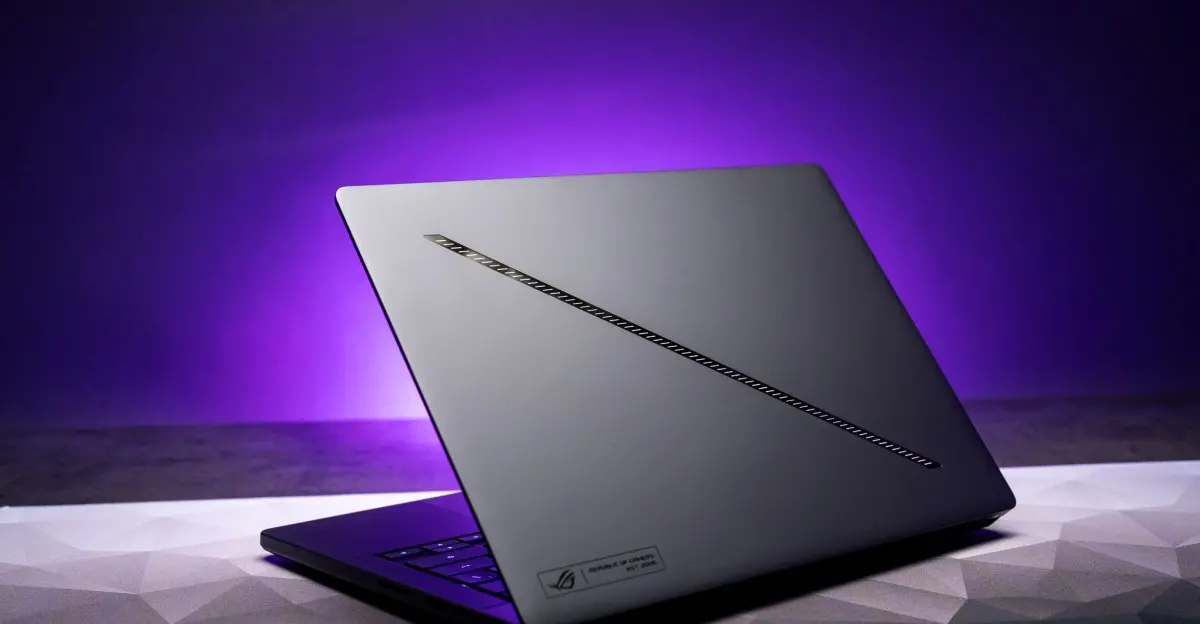
The Asus ROG Zephyrus G14 has been a staple in the gaming laptop segment since its debut in 2020. Known for blending portability with high performance, it quickly became a favorite among users who wanted a single device for both work and play. The 2026 iteration, now equipped with Intel’s Panther Lake processors, represents a significant shift from its AMD-powered roots. This review explores whether the new Intel-based G14 lives up to the legacy, focusing on its design, performance, battery life, and the ever-increasing price tag.
Design and Build Quality
The 2026 Zephyrus G14 retains the sleek, minimalist design language introduced with the 2024 redesign. The chassis is crafted from aluminum, giving it a premium feel while keeping the weight at a manageable 3.48 pounds (1.58 kg). The lid features an animated slash lighting effect with more LED segments than before, allowing for subtle customization. The bottom vents have been redesigned from rectangular slots to circular holes, improving airflow without compromising aesthetics. The overall dimensions are nearly identical to the 14-inch MacBook Pro, making it highly portable for a gaming laptop.
One of the most welcome additions is the full-size SD card slot, replacing the microSD slot found in previous models. This is a boon for photographers and videographers who need fast, direct transfer of media files. The port selection otherwise remains generous: two USB-C ports (one Thunderbolt 4, one USB 3.2 Gen 2), two USB-A 3.2 Gen 2 ports, HDMI 2.1, a 3.5mm combo audio jack, and Asus’ proprietary power connector. The Thunderbolt 4 upgrade offers faster data transfer and better compatibility with external docks.
Display and Audio
The 14-inch OLED panel boasts a resolution of 2880 x 1800 pixels and a 120Hz refresh rate. Colors are vibrant, blacks are deep, and brightness has been improved to 500 nits in SDR and up to 1,100 nits in HDR mode. This makes it suitable for both gaming and color-critical creative work. The display is factory-calibrated and covers 100% of the DCI-P3 color gamut, ensuring accurate color reproduction for photo and video editing.
Audio quality is surprisingly robust for a laptop of this size. Asus has packed six speakers into the chassis, including two woofers, delivering rich sound with a noticeable stereo soundstage. The speakers outperform most Windows laptops and come close to the MacBook Pro’s audio experience. However, for gaming or critical listening, headphones are still recommended.
Keyboard and Trackpad
The keyboard remains one of the best in the Windows laptop space. Key travel is deep and satisfying, with a tactile feel that rivals Lenovo ThinkPads. The keycaps are well-spaced and backlit, making typing comfortable for long sessions. The large mechanical trackpad uses a smooth glass surface and provides firm, tactile clicks. While it doesn’t click in all four corners (unlike some premium alternatives), it is responsive and accurate. Most gamers will use an external mouse anyway, so this is a minor quibble.
Performance and Gaming
Our review unit is equipped with an Intel Core Ultra 9 386H processor, an Nvidia GeForce RTX 5070 Ti Laptop GPU, 32GB of soldered LPDDR5X RAM, and a 1TB NVMe SSD. This combination delivers outstanding performance across the board. In productivity tasks such as photo editing in Adobe Lightroom Classic, the laptop feels snappy even on battery power. Editing 50-megapixel RAW files, applying presets, and exporting images were all handled with minimal lag. Multitasking with dozens of Chrome tabs, Slack, and music streaming was effortless, and the laptop remained cool and quiet during light workloads.
Gaming performance is where the G14 truly shines. In Battlefield 6, the laptop achieved 65-70 fps at native resolution with High settings without DLSS. Helldivers 2, which doesn’t support DLSS, ran at 80-90 fps at High settings. Marathon comfortably hit 70 fps with DLSS set to Quality. The GPU can reach a peak TGP of 130W (with dynamic boost), slightly higher than the previous generation’s 120W, providing a modest performance uplift. The bottom of the chassis gets warm during extended gaming sessions, but the keyboard deck remains comfortable, with only the left palm rest warming slightly.
Switching to Turbo mode via Asus’ Armoury Crate software overclocks the GPU by 50MHz and increases TGP by up to 20W, yielding an additional 5-10 fps in demanding titles. The fans become audible but not intrusive, making headphones advisable for the best experience.
Battery Life
One of the biggest improvements in the 2026 model is battery life, thanks to Intel’s Panther Lake architecture. In our battery rundown test, the G14 lasted over 17 hours, more than doubling the 8.5 hours of the previous AMD-based model. Real-world usage saw about 10 hours of mixed work (web browsing, video streaming, light photo editing) at 80% brightness. This is excellent for a gaming laptop and allows for a full workday away from a power outlet. When using the discrete GPU for gaming, battery life drops to around 5-6 hours, which is still respectable given the hardware.
The 73Wh battery can be charged via the included proprietary charger or through USB-C Power Delivery, though the latter may charge more slowly under load. The laptop supports fast charging, reaching 50% in about 30 minutes.
Comparison to Previous Generations and Alternatives
The 2026 G14 is undeniably powerful, but its price is a major sticking point. The reviewed configuration costs $3,600, while a nearly identical 2025 AMD model with the same GPU, RAM, and storage retails for around $2,600. For that $1,000 difference, you get better battery life, a brighter screen, a full-size SD card slot, and Thunderbolt 4. These are meaningful upgrades, but not everyone will find them worth the premium.
Consider the alternative: for the same $3,600, you could buy a 14-inch MacBook Pro with an M5 Max chip, which outperforms the G14 in CPU-intensive tasks and offers even longer battery life. Of course, the MacBook cannot game like the G14, so the choice depends on your priorities. Or you could split the budget: an entry-level MacBook Pro for work plus a Steam Deck or PlayStation 5 Pro for gaming, and still have money left over.
The last-gen G14 (with an AMD Ryzen AI 9 HX 370 and RTX 5070 Ti) is still available for under $2,000 on sale, making it a far better value. It offers nearly the same gaming performance and a slightly slower but still capable SSD. The only major sacrifices are battery life (around half) and the lack of a full-size SD card slot.
Specifications (as reviewed)
- Display: 14-inch OLED, 2880x1800, 120Hz
- CPU: Intel Core Ultra 9 386H (16 cores)
- GPU: Nvidia GeForce RTX 5070 Ti Laptop GPU (5,888 CUDA cores)
- RAM: 32GB LPDDR5X (soldered)
- Storage: 1TB NVMe SSD
- Webcam: 1080p with IR (Windows Hello)
- Connectivity: Wi-Fi 7, Bluetooth 6
- Ports: 1x Thunderbolt 4 USB-C, 1x USB-C 3.2 Gen 2, 2x USB-A 3.2 Gen 2, HDMI 2.1, full-size SDXC UHS-II card reader, 3.5mm audio jack
- Weight: 3.48 lbs (1.58 kg)
- Dimensions: 12.24 x 8.66 x 0.63-0.72 inches
- Battery: 73Wh
- Price: $3,599.99 as tested
The 2026 Asus ROG Zephyrus G14 is a remarkable laptop that excels at both creative work and gaming. Its beautiful OLED display, long battery life, solid build, and excellent keyboard make it a joy to use. However, the steep price—driven by global memory shortages and Intel’s premium—makes it a hard sell when last year’s model offers similar performance for significantly less money. If money is no object and you want the best single-laptop solution available today, the new G14 is it. But for most people, the $1,000 savings of the AMD version is a smarter choice.
Source: The Verge News