

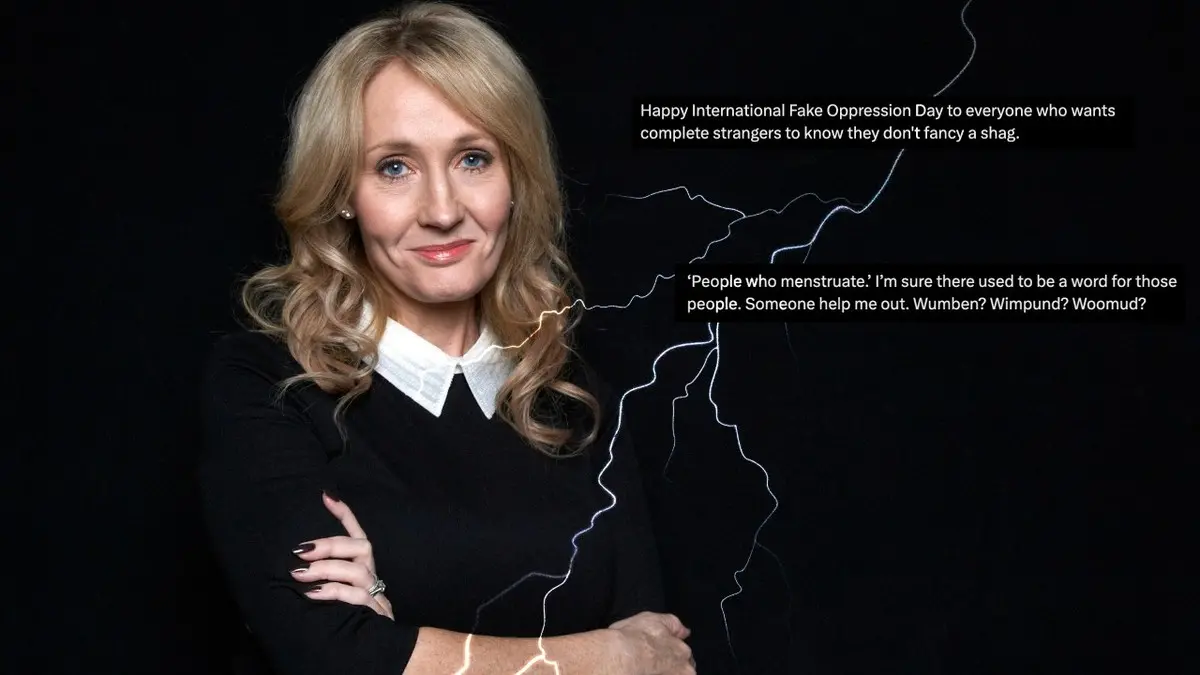
J.K. Rowling, the author of the globally beloved Harry Potter series, has become a polarizing figure over the past five years due to repeated statements widely condemned as transphobic. Starting in June 2020, her comments on social media sparked outrage, leading to public backlash from fans, fellow celebrities, and even the stars of her own franchise. This timeline traces the key scandals, from her initial tweet about “menstruating persons” to her celebration of a UK Supreme Court ruling that excludes transgender women from the legal definition of women.
The Beginning: The Tweet That Started It All
On June 7, 2020, Rowling criticized an article that used the phrase “people who menstruate” instead of “women.” She tweeted sarcastically: “I’m sure there was a word for those people. Help me out. Wumben? Wimpund? Woomud?” The post immediately drew sharp criticism for mocking inclusive language. When confronted, Rowling doubled down, arguing that “if sex isn’t real, there’s no same-sex attraction” and that the concept of biological sex should not be erased. She framed her views as protecting women’s rights, a stance that many critics label TERF (trans-exclusionary radical feminist) ideology.
On June 10, 2020, she published a lengthy essay on her website titled “J.K. Rowling Writes about Her Reasons for Speaking out on Sex and Gender Issues.” In it, she expressed concern about the rising number of young women seeking gender transition and cited unsubstantiated claims about high regret rates. She also used the hashtag “TERF Wars,” which further inflamed tensions. Many pointed out that the regret rate for gender transition is actually very low—around 1%—and that trans youth face elevated suicide risks when denied support.
Reactions from the Harry Potter Cast
The response from the actors who brought her characters to life was swift and unequivocal. Daniel Radcliffe, who played Harry Potter, issued a statement through The Trevor Project, a suicide prevention organization for LGBTQ+ youth. He said: “Transgender women are women. Any statement to the contrary erases the identity and dignity of transgender people.” Emma Watson, who portrayed Hermione Granger, tweeted: “Trans people are who they say they are and deserve to live their lives without being constantly questioned or told they aren’t who they say they are.” She also donated to trans-supporting charities. Rupert Grint, who played Ron Weasley, told the Sunday Times: “I firmly stand with the trans community.” All three have since distanced themselves from Rowling.
The Books: ‘Troubled Blood’ and Accusations of Transphobia
In September 2020, Rowling published a crime novel, “Troubled Blood,” under her male pseudonym Robert Galbraith. The plot involves a serial killer who dresses as a woman to lure female victims. The Telegraph described it as “a book whose moral seems to be: never trust a man in a dress.” Critics accused Rowling of using fiction to propagate transphobic stereotypes. The hashtag RIPJKRowling trended on Twitter as fans expressed their disillusionment.
Comparing Trans People to Death Eaters
In March 2023, Rowling participated in the podcast “The Witch Trials of J.K. Rowling” produced by The Free Press. During the interview, she compared trans rights activists to the Death Eaters from Harry Potter—the followers of Lord Voldemort who seek to purge non-magical beings. She stated: “The Death Eaters claimed, ‘We were forced to live in hiding, and now our time has come, and anyone who stands in our way must be destroyed.’ They demonized and dehumanized those who were not like them.” The analogy was widely condemned as a misrepresentation of the trans community’s struggle for equality.
‘I’d Rather Go to Prison’ – Defying Hate Speech Laws
When the UK government announced plans to criminalize hostility based on gender identity in October 2023, Rowling responded defiantly on Twitter: “I’ll happily serve two years in prison if the alternative is to deny reality.” She reiterated her belief that trans women are men and that legal protections for trans people undermine women’s safety. When Scotland enacted a hate crime law in April 2024, she repeated her willingness to be incarcerated, saying she could not defend women if “a man can simply call himself a woman.” Critics note that undergoing gender transition is a complex medical and social process, not a simple declaration.
Misidentifying an Olympic Boxer
During the 2024 Paris Olympics, Rowling sparked a major controversy by claiming that Algerian boxer Imane Khelif was a man. Khelif had been assigned female at birth and competed legally as a woman, but Rowling posted a photo of her fight against Italian Angela Carini, writing: “Could any picture sum up our new men’s rights movement better? The smirk of a male who knows he’s protected by a misogynist sporting establishment.” Khelif, who is not trans, later filed a cyberbullying lawsuit against Rowling and Elon Musk for inciting harassment.
Attacking Asexual People
On International Asexuality Day, April 6, 2025, Rowling tweeted: “Happy International Day of Fake Oppression to all who want to let complete strangers know they don’t fancy sex.” The post was seen as mockery of asexual people, extending her hostility beyond the transgender community to other parts of the LGBTQ+ spectrum. Many replied urging her to “leave people alone.”
Rejoicing Over a UK Supreme Court Ruling
On April 16, 2025, the UK Supreme Court ruled that the concept of sex is binary for the purposes of the Equality Act 2010—meaning transgender women are not legally recognized as women for protections such as quotas or single‑sex spaces. Rowling celebrated by posting a photo of herself smoking a cigar with the caption “I love it when a plan comes together,” hashtags SupremeCourt and WomensRights. Reports indicate she donated $70,000 to For Women Scotland, the group that brought the case.
The Boycott Movement
As a result of these repeated controversies, a growing number of fans and activists are calling for a boycott of all Harry Potter content. Social media users, including some who built their channels around the franchise, urge others to stop watching the films, buying merchandise, and even streaming the upcoming HBO series adaptation. One TikTok creator lamented: “I will never watch Harry Potter again. This horrible, disgusting shit must have consequences.” Actor Pedro Pascal, whose sister is a trans woman, amplified the boycott call by commenting on a viral video and wearing a “Protect the Dolls” T‑shirt that supports Trans Lifeline. The Harry Potter franchise remains immensely profitable, but the cultural rift between Rowling and a significant portion of her audience continues to widen.
Rowling’s influence as a public intellectual and philanthropist has been permanently altered. While she maintains that she is defending women’s rights, many argue that her rhetoric fuels discrimination against an already marginalized community. The legacy of Harry Potter now exists in tension with its creator’s activism, forcing fans, corporations, and institutions to grapple with the question of separating art from the artist. As the legal landscape in the UK shifts and more individuals speak out, the debate shows no sign of resolution.
Source: watson.ch News